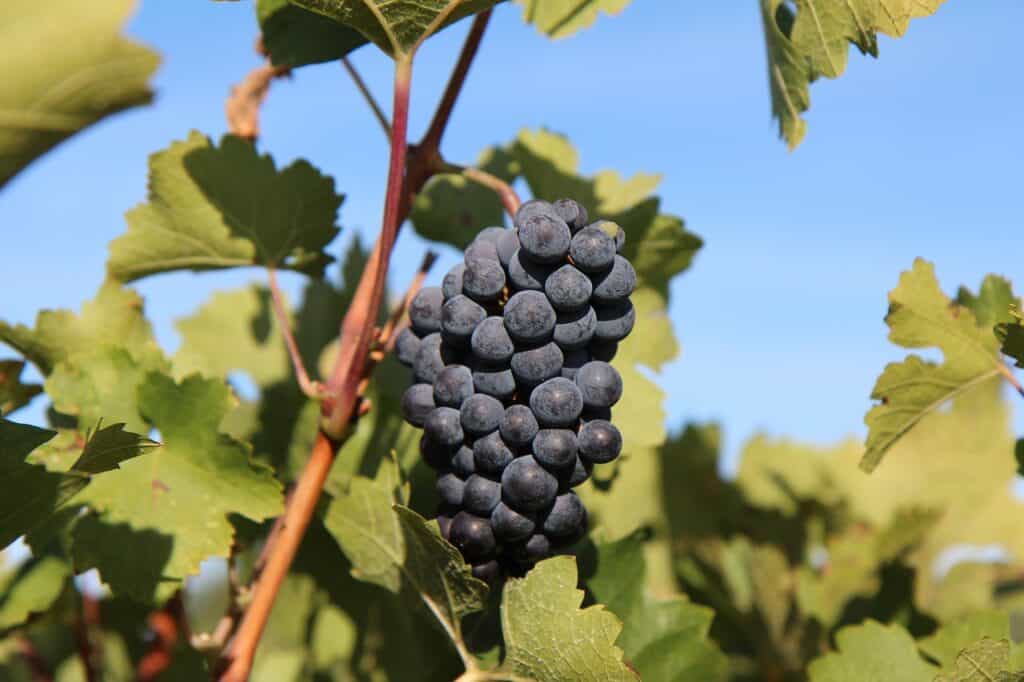
Marquette is a cold-hardy red wine grape developed at the University of Minnesota, released in 2006, and now the most widely planted wine grape in the upper Midwest. It survived -36°F in Minnesota trial plots without significant vine death. It produces wines with tannin structure, dark fruit, and enough complexity to age — qualities no other cold-climate red consistently delivers at that level of hardiness.
If you’ve spent any time exploring Minnesota wine country, you’ve encountered Marquette. It’s on nearly every menu, in nearly every vineyard, and for good reason.
Where Marquette Comes From
The University of Minnesota’s Horticultural Research Center released Marquette after two decades of cold-climate viticulture research. Its parentage traces through MN 1211 to Pinot Noir on one side and Vitis riparia — a wild grape species native to northern North America — on the other. That riparia influence is what gives it the cold hardiness. The Pinot Noir lineage is what gives it the structure.
The grape’s name honors the French Jesuit missionary Jacques Marquette, who explored the upper Mississippi River region in the 1670s. The University released it alongside two other varieties the same year: Frontenac Gris and La Crescent. Of the three, Marquette has spread furthest — it’s now grown in Wisconsin, Iowa, North Dakota, and across the northeastern U.S.
What Marquette Tastes Like
The flavor profile
Marquette produces wines with aromas of black cherry, plum, black pepper, and sometimes a pronounced spice note — clove or cinnamon — that winemakers either suppress or lean into depending on their style. Tannins are present and structured, which is unusual for a cold-climate red. Acidity is naturally high, which keeps the wine fresh and food-friendly.
The best Minnesota bottlings land somewhere between a Côtes du Rhône and a lighter Cabernet Franc. They’re not heavy wines, but they have enough backbone to hold up to roasted meat, aged cheese, and game.
Style variation
Winemakers approach Marquette differently. Some produce it as a light, fruit-forward style with minimal oak — drink-now wines meant to show off the grape’s natural brightness. Others age it in French oak for 12–18 months, developing vanilla and tobacco notes alongside the fruit. A third group focuses on rosé, where Marquette’s natural acidity and cherry character produce some of the most interesting cold-climate pink wines made anywhere.
Port-style dessert wines from Marquette are also common in Minnesota tasting rooms. The grape’s sugar potential and structure make it well-suited to fortified styles.
Cold Hardiness: What the Numbers Mean
The University of Minnesota Horticultural Research Center rated Marquette hardy to -36°F at the bud level in controlled trials. For context, the USDA Plant Hardiness Zone for most of Minnesota’s wine country is Zone 4b, where average annual extreme minimums run -25°F to -20°F. Marquette has margin to spare.
That margin isn’t just about survival — it’s about consistency. Grapes that regularly suffer winter damage produce uneven crops. Damaged buds either don’t produce fruit or produce fruit from secondary buds, which are lower in quality. Marquette’s cold tolerance means Minnesota vintners can plan for consistent harvests in a way that wasn’t possible before the University breeding program.
Where to Find Great Marquette
Cannon River Valley
The Cannon River Valley southeast of the Twin Cities is Marquette’s home territory. Cannon River Winery in Cannon Falls grows estate Marquette on 20 acres in the Sogn Valley — their wine consistently places in regional competitions. Alexis Bailly Vineyard in Hastings, Minnesota’s oldest winery, produces Marquette as part of an estate program that dates to 1973 and has been refining cold-climate techniques longer than almost anyone.
Beyond Minnesota
Marquette has spread to Wisconsin, where Parallel 44 Winery in Kewaunee produces a cold-climate estate Marquette that’s worth seeking out. In Michigan, a handful of producers in the Upper Peninsula and the Traverse City region have planted it as a complement to the more established vinifera varieties. Iowa, North Dakota, and several northeastern states now grow it as well.
For ordering wine without making the drive, several Minnesota Marquette producers ship nationally. Search for Marquette wines on Amazon to find bottles from Minnesota producers available online.
Plan Your Visit
The best time to visit Marquette country is September and October, when harvest is underway and tasting rooms are at their liveliest. Most Cannon River Valley wineries run weekend-only hours outside summer. Call ahead before making the drive — tasting room schedules in Minnesota wine country change seasonally.
For the full regional guide — wineries, maps, best visiting seasons, and what to order at each stop — see the Minnesota Wine Country Guide and the Cannon River Valley region page.